

Understanding the Immunological Problem
The engineered sequence sits deep within the assembled capsid, where structural constraints and competing epitopes make it difficult for the immune system to detect. Even when partially exposed, it must compete with highly immunogenic capsid surfaces that dominate the response. Rabbits offer a broader immune repertoire and can detect subtle epitopes, but the antigen still needed to be presented in a way that directed their response toward the engineered region.
Strategic Immunogen Design
To overcome epitope competition, ExonBio used both native rAAV particles and a synthetic peptide containing the engineered sequence with flanking residues. The capsid preserved conformational context, while the peptide isolated the engineered region and prevented it from being masked. Immunizing multiple rabbits across both formats broadened the B‑cell repertoire and increased the likelihood of generating antibodies that truly recognized the modified sequence.
Deep‑Well ELISA Screening Summary
The deep‑well ELISA results showed strong binding to the engineered DAD capsid, indicating that the immune response successfully generated B‑cell populations targeting the modified region. Non‑target capsids displayed only moderate background signals, while baseline wells remained low. Overall, the screening pattern confirmed the presence of promising antibody‑secreting clones suitable for downstream monoclonal isolation.
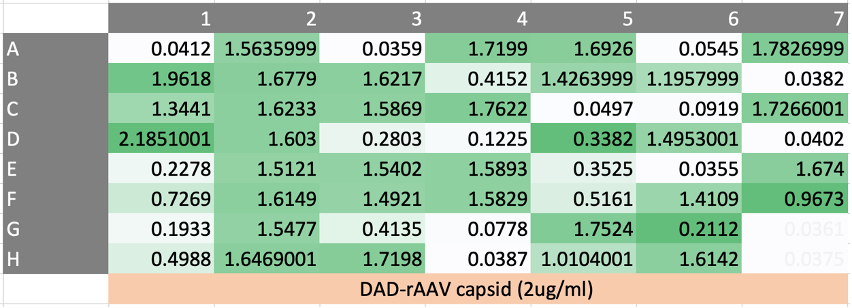
Figure 1. Deep well ELISA screening of rabbit B cell supernatants against the engineered DAD capsid.
Antibody Discovery Using the SPIN® Platform
With the immune profile established, Exonbio used its SPIN® platform to isolate antigen‑specific plasma cells. The sorting strategy employed the target capsid as the positive probe and all non‑target capsids as counter‑selection probes, ensuring that only engineered‑epitope binders advanced. Recovered heavy and light chain sequences were expressed and screened against the full capsid panel to confirm specificity.